The Sustainable Mobility Plan “Better Through Cologne”: How the City of Cologne is Shaping Sustainable Mobility – and Meeting European Ambitions
Cologne stands at a crucial crossroads: by 2027, as one of the 432 “Urban Nodes” of the Trans-European Transport Network, it must present a Sustainable Urban Mobility Plan (SUMP). SUMPs are a key element of the EU strategy to promote environmentally friendly transport solutions and improve the quality of life in European cities. In this blog, our colleague Helene Loy discusses what has been achieved in the first stage of the SUMP process, and the insights that shape the way ahead.
This represents a significant step forward for Cologne. The last comprehensive overall transport concept dates back to 1992. Since then, the city, mobility, and societal needs have changed. The new sustainable mobility plan, Better Through Cologne, is designed to close this gap. It builds on the strategy paper “Cologne Mobile 2025” and the urban strategy “Cologne Perspectives 2030+”. Together, they create a mobility framework that connects efficient traffic flows, healthy living spaces, and forward-looking urban development.
Moving from Strategy to Implementation
After Mobycon, together with a large consortium of mobility planning and communication experts, supported the City of Cologne in the first phase of the mobility plan in developing a target scenario and suitable strategic measures, the second phase now aims to make this work more concrete. In collaboration with the city and our consortium, we are developing concrete measures to bring the objectives to life.
Before we embark on the next stage, it is worth looking back with the Cologne project team: what did we achieve with the city in the first stage of the SUMP process, and what insights shape the way ahead?
The first stage showed: in Cologne, a wide variety of voices and perspectives come together – administration, associations, and citizens of all ages have had their say. The (literally award-winning) participation process for the mobility plan was clearly more than a formality: it was comprehensive, broad-based, and well coordinated. In recognition of this practical approach, Cologne received the “Good Citizen Participation” award from the Competence Centre for Citizen Participation e. V. in October 2024. The extent to which the contributions from the participating target groups have been incorporated into the mobility planning is evident in the status quo analysis. There, participation results were compared and combined with quantitative analysis, and the combined findings were directly integrated into the status quo analysis. We are also continuing this sound linkage in the second phase to derive practical measures from the strategy.
From Technical Depth to Public Understanding
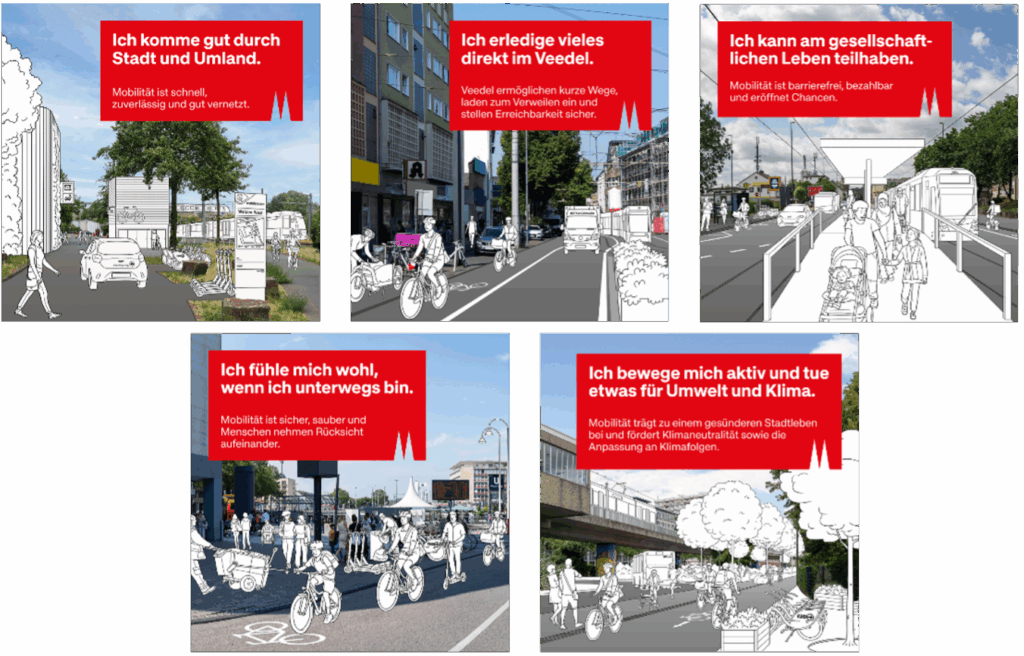
Five target visions for mobility in Cologne aim to bring together different perspectives and provide a clear framework for orientation. Together, they form a guiding vision that informs further planning. The guiding vision process led to intensive exchanges over several rounds of participation. Bringing together diverse opinions was challenging but provided a stable foundation for the next steps. The visual presentation of the target visions (see graphic below) and the first-person perspective wording also helped Cologne’s citizens to identify with the visions for the future.
At the same time, it became clear how challenging it is to communicate the complexity of the SUMP to the outside world. From adjustment levers and strategic measures to strategy scenarios, target scenarios, and indicators: all these terms have emerged in the development of the sustainable mobility plan. Again and again, it was necessary to strike a balance between technical depth and general comprehensibility. How can you provide orientation, enable participation, and make decisions understandable without losing oversight? This challenge has shaped the process.
Friederike Christian is project manager for the SUMP in the City of Cologne. She says:
“We are now aware of the problems and potentials. The crucial step is to move on from these insights to implementation. That’s why a structured implementation concept with clear roles and priorities is essential for our SUMP.”
On this basis, the second stage of the sustainable mobility plan began in early September 2025. The task is to translate the results of the first stage into concrete measures that will noticeably change mobility in Cologne by 2035. The developed target visions serve as a compass.
A particular challenge is the city’s strained budget situation. But therein also lies an opportunity, says Friederike Christian:
“When resources are scarce, you need clear priorities and a transparent roadmap for when which measures can be implemented. This creates commitment and makes it easier for political committees as well as specialist departments to make decisions.”
We are currently working together with our partners (Dialogwerke, Mobilité, and Inovaplan) and with the City of Cologne on a multi-stage process to develop the package of measures. We need measures that consistently contribute to the overarching goals and are realistically feasible. A broad participation process accompanies our work and ensures that the perspectives of administration, politics, and the community remain anchored even in the implementation phase.
Our project team is building on the successful work of the first stage. We are bringing our experience from European SUMP processes into this second phase. Our aim is to provide the city with an implementation plan that is not only technically sound but also offers practical guidance and facilitates decision-making.
We are very pleased to contribute to ensuring that Cologne will, in the future, have a clear plan from strategic objective to practical realisation, laying the foundation for structured implementation.
For Cities Just Starting Their Own SUMP Process, Friederike Christian Has Some Valuable Recommendations:
Reduce complexity and become more pragmatic. Strategic concepts can quickly appear academic and abstract to outsiders. Pragmatic language makes participation easier and communication clearer.
Use tools to create identity. The target visions, presented in the first person, and the visualisations help citizens identify with the process and the eventual product.
Make connections visible. In Cologne, political proposals and publications on sustainable mobility are now closely linked to the SUMP and its objectives, making it easier for people to understand the connections between individual street-level measures and the “bigger picture”.
Want to learn more about how we can support your city in the SUMP process?Don’t hesitate to reach out to us!