Velo-city 2023: Building a bridge between holistic strategies/vision and planning practice
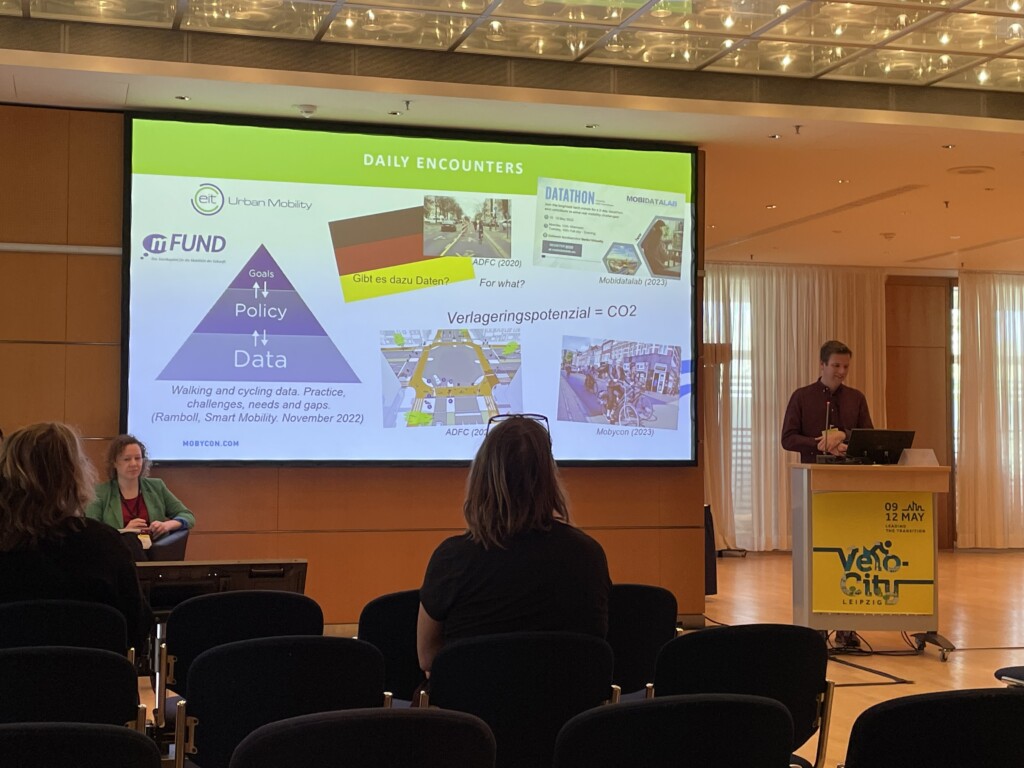
In May I was very happy to present on one of the major challenges facing the uptake of cycling in Europe: The ‘fetishism’ of quantitative data and traffic models for policy making and planning. A short summary of my presentation can be found here, and on the Velocity programme website under the session: ‘Not an end in itself: Technologies that impact cycling session’; and presentation title: ‘Computer says no – Data fetishism blocking a cycling transformation’. Of course, many thanks to Velo-city for the opportunity to present, as well as to the moderator Anna Clarke and the other presenters from Amsterdam, Delft, and Helsinki.
Erik Ooms at Velo-city 2023
The main theme of this year’s conference was Leading the Transition. The plenary session speakers were amazing, providing strategic perspectives on where we need to go. From Carlos Moreno presenting on cycling in the 15-minute city, presentations on the importance of viewing public space as more valuable than focusing solely on traffic space and flows, and a very interesting non-European view on institutional racism and the empowerment function of the bike.
With these themes and ideas in mind, I aimed to keep within the same sentiment, beginning my presentation with the acknowledgement that quantitative data is relevant for assessing a situation broadly and creating awareness (e.g. air pollution). However, it is important to not embrace it too much, and to ensure that the story behind the data is always kept in mind. Do not fall victim to the same mistakes as traffic planners in decades passed, focusing on efficiency and speed for vehicles while destroying public space and human scale mobility.
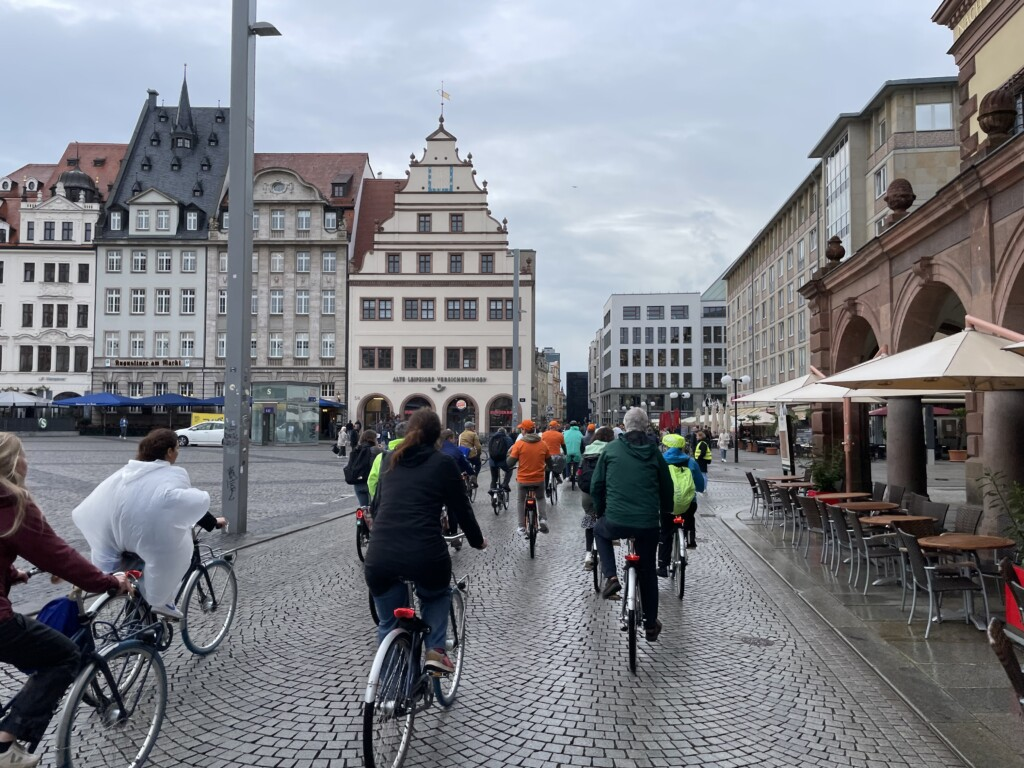
Velo-city 2023 Bike parade
It is time to work normatively, asking ourselves what kind of city we want to live in, to collect qualitative data that involves talking with people about their mobility and accessibility needs as cyclists and pedestrians. It is also time to empower underrepresented groups–people with a migration background, children, seniors, disabled, and neurodiverse people–who have been left out of many transportation discussions, and to plan for them. Quantitative data and models have not helped us to date, and to continue in this manner will probably only lead to increased car traffic and more societal inequities.
Simply saying this is relatively easy. Actually putting these principles into practice is the most difficult challenge. How do we address the need for a shift to a more human-centered, qualitative approach in a space where:
Generally, the transfer from holistic, grassroots, cross-sectoral, and systems oriented strategies and visions towards traffic planning practice struggle to find success?
Even the most progressive traffic planners find translating the new narrative into their sketches and ideas a challenge?
Despite a desire to change the approach or work differently, planners are met with the need for ‘data-argumentation’ from politicians and higher administrative levels?
My takeaway from Velo-city is that as a cycling community we now have a clearer strategic direction on the horizon that can take us where we want to go to. What we need to do now is further strengthen the bridge between strategies and visions on the one side and practitioners on the other. Instead of funding more data collection, we must dedicate more resources towards capacity building and training in the coming years. Innovative training programmes that focus on how to better listen to each other, hear what is being said, and gives space for ongoing, informal exchange between practice and strategy rather than sporadic updates. With lots happening in the areas of new ways of ‘learning,’ we should also include progressive pedagogic experts in developing these trainings and exchange formats, and make better use of these improvements.
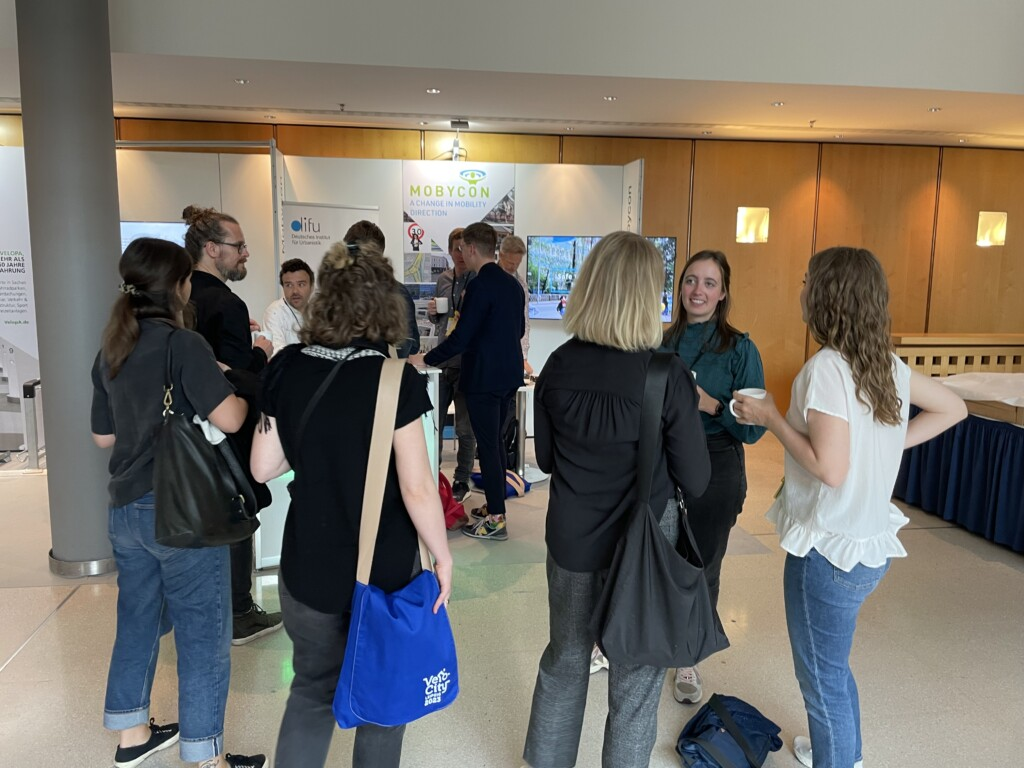
Mobycon’s booth with the Deutsches Institut für Urbanistik (Difu) at Velo-city 2023
I ended my presentation by saying, “We [Mobycon] are not the new Jane Jacobs, but I hope she/he/they is walking around somewhere.” Even so, many of us at Mobycon have great ideas and passion within the fields of visioning, strategies, qualitative research, learning, capacity building, etc. If you have some interesting challenges you are facing with in your city or region, or if you want to collaborate with us on solving these challenges in other ways beyond solely the use of quantitative data or models, get in touch!
Velo-city 2023: Building a bridge between holistic strategies/vision and planning practice
The main theme of this year’s conference was Leading the Transition. The plenary session speakers were amazing, providing strategic perspectives on where we need to go. From Carlos Moreno presenting on cycling in the 15-minute city, presentations on the importance of viewing public space as more valuable than focusing solely on traffic space and flows, and a very interesting non-European view on institutional racism and the empowerment function of the bike.
With these themes and ideas in mind, I aimed to keep within the same sentiment, beginning my presentation with the acknowledgement that quantitative data is relevant for assessing a situation broadly and creating awareness (e.g. air pollution). However, it is important to not embrace it too much, and to ensure that the story behind the data is always kept in mind. Do not fall victim to the same mistakes as traffic planners in decades passed, focusing on efficiency and speed for vehicles while destroying public space and human scale mobility.
Velo-city 2023 Bike parade
It is time to work normatively, asking ourselves what kind of city we want to live in, to collect qualitative data that involves talking with people about their mobility and accessibility needs as cyclists and pedestrians. It is also time to empower underrepresented groups–people with a migration background, children, seniors, disabled, and neurodiverse people–who have been left out of many transportation discussions, and to plan for them. Quantitative data and models have not helped us to date, and to continue in this manner will probably only lead to increased car traffic and more societal inequities.
Simply saying this is relatively easy. Actually putting these principles into practice is the most difficult challenge. How do we address the need for a shift to a more human-centered, qualitative approach in a space where:
Generally, the transfer from holistic, grassroots, cross-sectoral, and systems oriented strategies and visions towards traffic planning practice struggle to find success?
Even the most progressive traffic planners find translating the new narrative into their sketches and ideas a challenge?
Despite a desire to change the approach or work differently, planners are met with the need for ‘data-argumentation’ from politicians and higher administrative levels?
My takeaway from Velo-city is that as a cycling community we now have a clearer strategic direction on the horizon that can take us where we want to go to. What we need to do now is further strengthen the bridge between strategies and visions on the one side and practitioners on the other. Instead of funding more data collection, we must dedicate more resources towards capacity building and training in the coming years. Innovative training programmes that focus on how to better listen to each other, hear what is being said, and gives space for ongoing, informal exchange between practice and strategy rather than sporadic updates. With lots happening in the areas of new ways of ‘learning,’ we should also include progressive pedagogic experts in developing these trainings and exchange formats, and make better use of these improvements.
Mobycon’s booth with the Deutsches Institut für Urbanistik (Difu) at Velo-city 2023
I ended my presentation by saying, “We [Mobycon] are not the new Jane Jacobs, but I hope she/he/they is walking around somewhere.” Even so, many of us at Mobycon have great ideas and passion within the fields of visioning, strategies, qualitative research, learning, capacity building, etc. If you have some interesting challenges you are facing with in your city or region, or if you want to collaborate with us on solving these challenges in other ways beyond solely the use of quantitative data or models, get in touch!



 ">
">