


blog
May 2026
Une nouvelle expertise sur les routes : utiliser le standard européen de certification (ECS) pour améliorer les itinéraires cyclables
Read moreblog
April 2026
It is summer in the Northern Hemisphere. In Europe, which is heating twice as fast as the global average, entire national conversations have turned to the heat and how to mitigate it. Tens of millions of Europeans, especially those north of the Mediterranean, are confronted with a set of urgent collective decisions that must be taken in parallel: How can large, busy, heavily-used rail systems be heat-proofed? Where is one’s nearest cooling centre? What does the city heat officer say about improved sun shading?
For Mobycon, summer brings with it a more targeted set of questions about cycling, walking, and extreme heat. In Dubai, in 2023, I delivered a capacity-building programme on cycling with the city’s roads and transport authority. A senior officer asked me a very reasonable question: “How can we invest in a good cycle network when it is 50° C during the day in summer? Who will cycle then?”. In a very short span of time, this question has become relevant to Europe, where heat records now climb by whole numbers in a single year.
The argument runs as follow:
This argument sounds reasonable at first – much like the one that car-dependent societies simply reflect the preferences of users. However, a few short cycling trips around European cities this summer have reminded me that there is an extensive toolkit of measures – some new, but mostly very old – that can redesign the cycling ‘envelope’, and thereby who gets to cycle in comfort and safety, all year round.
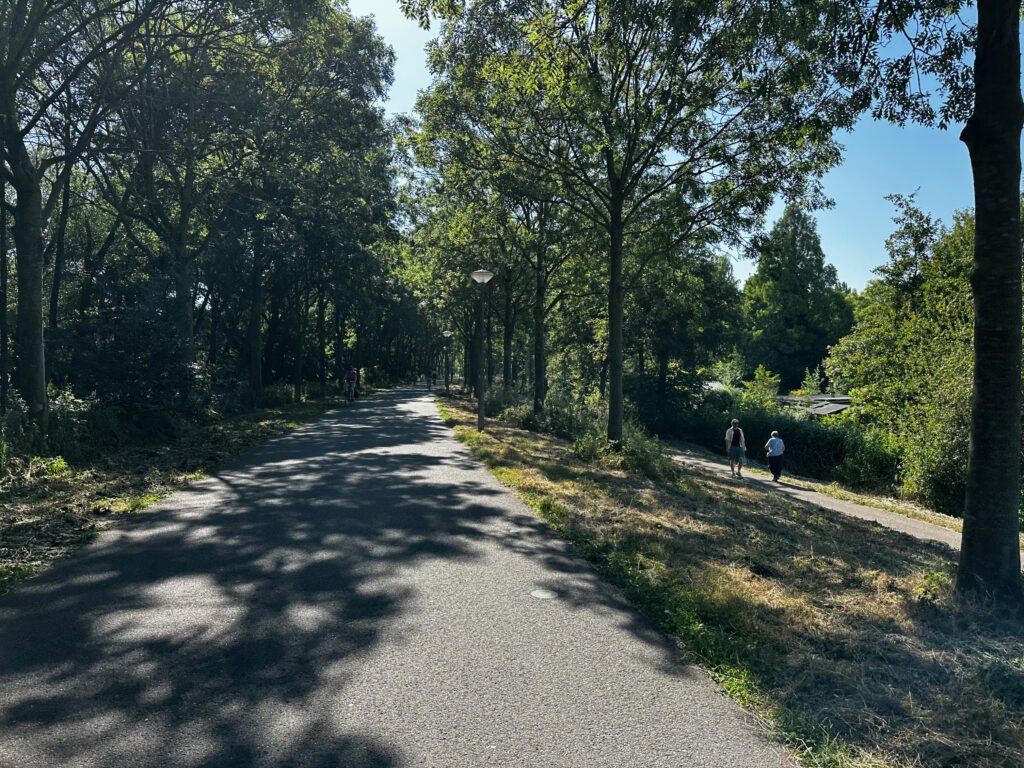
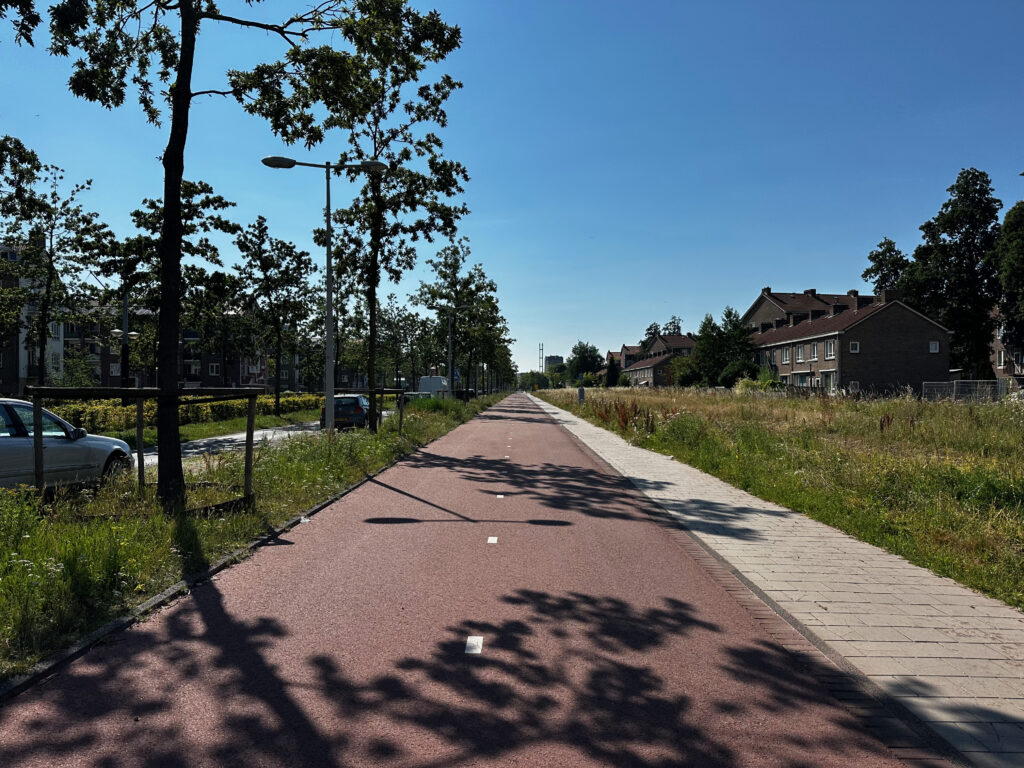
The first measure is shade. Not just an island of shade here and there, in which people cluster while waiting at traffic lights, but a strategic shade network. By this, I mean a process by which cities map shade for the hours at which incoming solar radiation peaks, andstart to treat shade like any network: as an element that should extend along the cycling network, continuing from linear sections through intersections. This could look like long stretches of shade trees planted along cycle routes, but also awnings or shade cloths fixed to buildings at intersections.
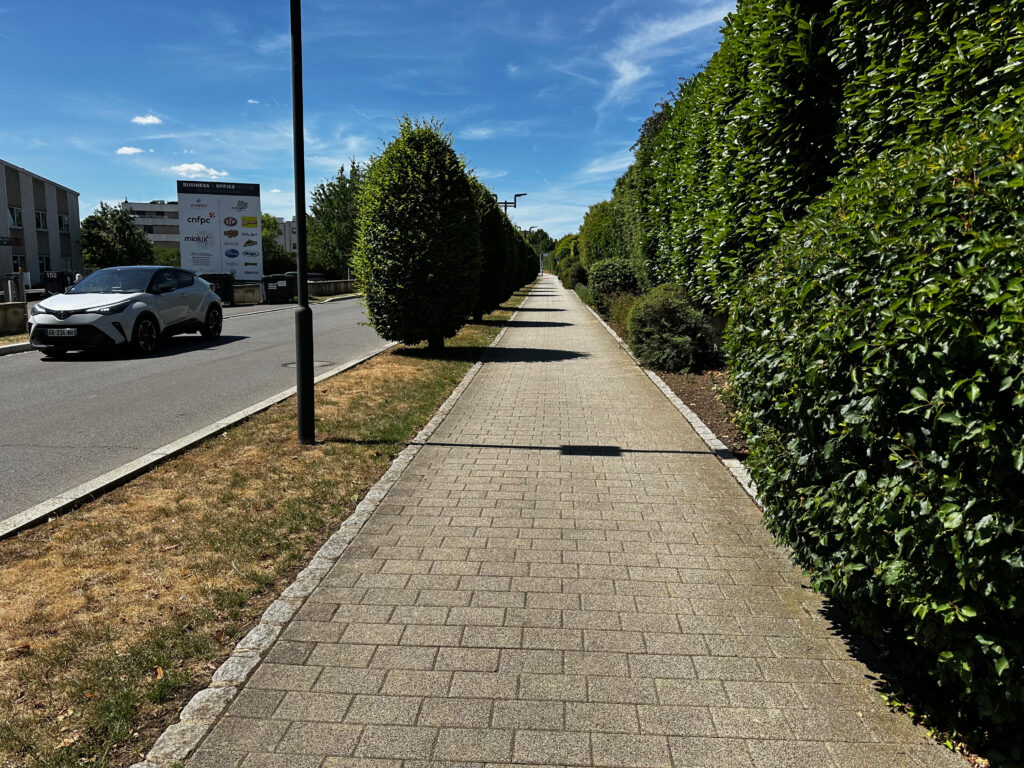
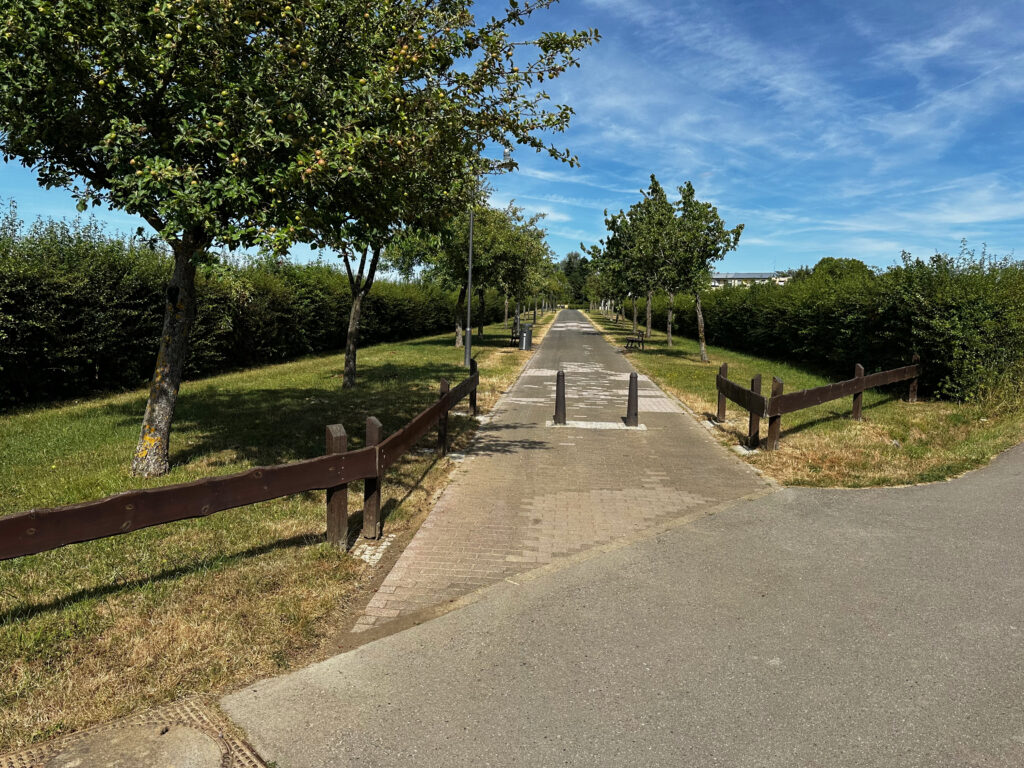
Take a walk or a ride around a northern European city this summer and note how often the trees you see near cycling infrastructure are ornamental and provide little shade, or how often trees in the street are positioned to shade parked cars, leaving sidewalks and cycle links exposed to the full sun. These trees are beautiful and beneficial in themselves, but if they do not provide what we might call ‘useful shade’, we are in effect asking cyclists to spend their travel time in continuous exposure to full sun – thereby ensuring that only the hardiest and most resilient will continue to see cycling as a spontaneous mode of transport on summer days.
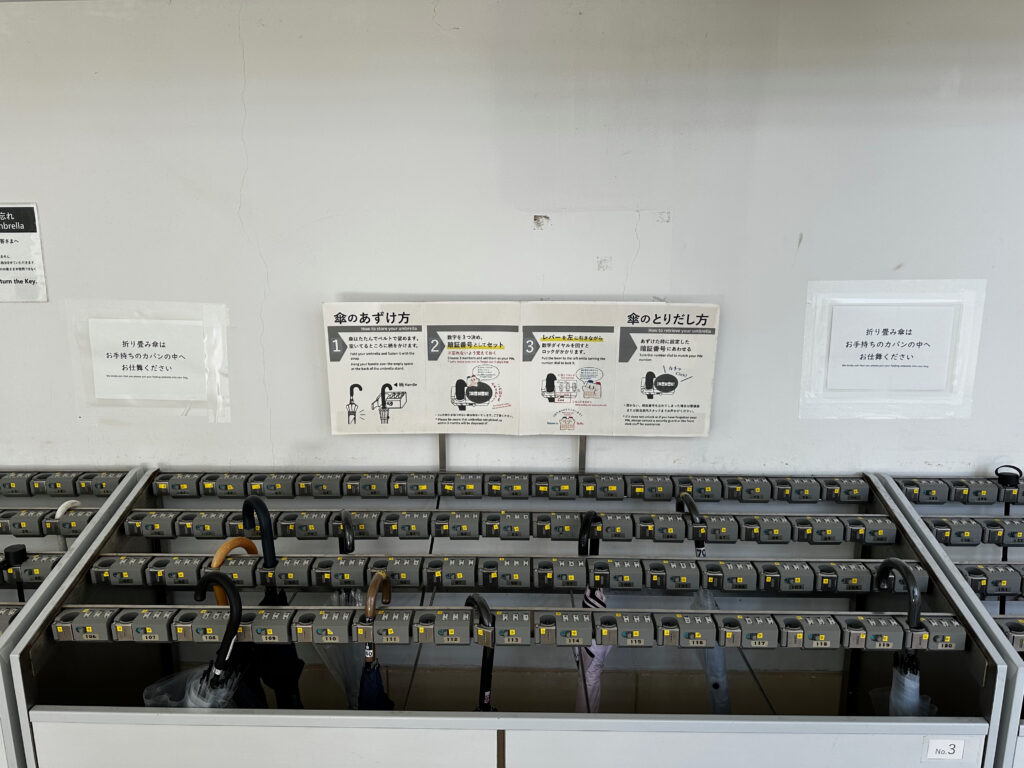
Of course, cyclists can and should protect themselves from the sun by wearing hats and caps, and by applying sunscreen. But time spent in Japan, where parasols (sun umbrellas, often with UV protection) are widely used, has recently brought home to me the difference between a sun barrier on the body, and a sun barrier well away from the body. Cyclists can shade their own individual bodies, but this is less effective than infrastructural protection that shades their entire body (in fact, the entire cycling envelope through which they move), rather than just the head, and prevents the ground beneath them (if asphalt, paving, or another thermal battery) from heating up in the first place.
In Amsterdam, I have started to notice how much of my long (8km) commute to town is deeply shaded by thickly planted mature trees. I notice that I take the shaded, longer route to the city centre almost every time, and will only favour the shorter, direct, sun-exposed route when winter really sets in. When I enter the city centre, this shade mostly disappears, and I notice instantly that a sort of timer starts ticking the first time I am forced to wait for a green light in full sun: I register my discomfort, and look over at people next to me sitting in air-conditioned comfort in a car, and wonder why there is space for cars that carry, on average, 3 empty seats on every trip, while there is no space for me to wait in the shade of a tree or a simple shade cloth.
In part, this shade is no accident: Amsterdam has long routed major cycling routes through its largest city parks, where shade is abundant or easily created. This is a departure from the cultural image of parks in many European cities. Europe’s great city parks are often treasured as a refuge from crowds and movement, while the cycling route through the Vondelpark can carry more than 25,000 fast-moving cyclists in a single day. This juxtaposition – a heavily-used transport corridor passing straight through a place of leisure – is not without challenges. But it is a long, strategically located corridor that offers people cycling and walking the cooling and shade of deep tree cover (see the work of the UK’s Woodland Trust for thermal imaging of urban trees). It could be the backbone of a future strategic shade network for Amsterdam’s cyclists in the drier, hotter, more extreme weather of the immediate future.
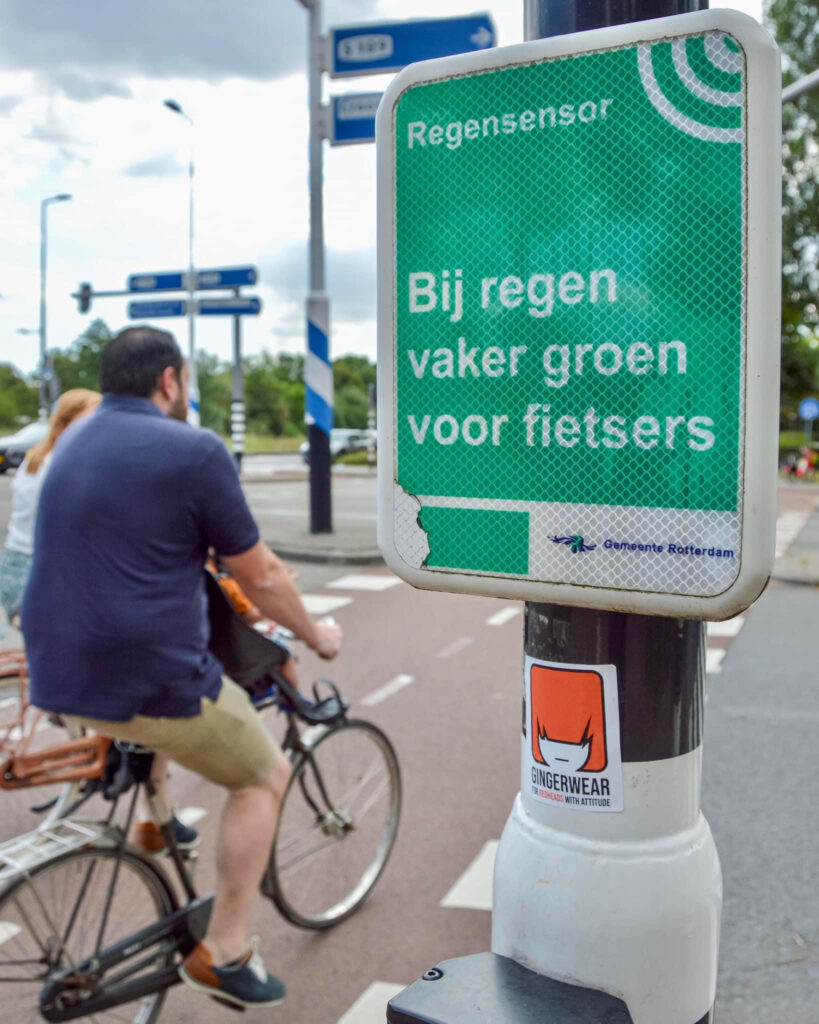
Some Dutch cities have experimented with, and permanently adopted, measures that give people cycling and walking more priority and shorter waits at signalised intersections when it is raining. In Mobycon’s work on a major micromobility plan for a city in the United Arab Emirates, we proposed an equivalent measure for the hottest weeks of the year. This would minimise the time that people using micromobility lanes – sometimes cyclists, but more often motor scooter riders – spend waiting in full sun at intersections. Standard, long-established measures in the Dutch cycling design toolkit – like removing as many compulsory stops as possible on primary cycling networks – deliver a large and predictable decrease in the time (and physical effort) that is lost when cyclists are forced to come to a stop simply because they are convenient for motorists.
We have long known that shade can make a dramatic difference in temperature, and that the cooling effect of evaporation from plants can reinforce this. But the many measures described above – short-term and long-term, experimental and established – are fundamentally about protecting people from heat that is already there. But what about the injection of heat onto city streets?
Moving cars themselves inject a significant amount of heat onto city streets, mostly from combustion engines. When car traffic peaks, the effect can compound rapidly in combination with car emissions (smog). In Singapore, a sort of living laboratory for the study of systemic heating and cooling of the urban fabric, research has shown that even if the city’s car fleet were converted entirely to electric vehicles, which emit far less heat than combustion engines, car traffic would still raise air temperatures.
Part of the reason is the vast amount of surface space that cars require – the city of Amsterdam’s guidelines state that a car moving at 50km/h inside the city requires an average of 150 m2 of road space. All this asphalt functions as a thermal battery, for as long as it is exposed to the sun. The space appropriated by moving and parked cars cannot serve other priorities that directly mitigate heating, like (re-)vegetation or seating (so that people can pause on a walking journey), because an ideal surface for driving is mostly incompatible with these aims.
At Mobycon, our work has often called into question the amount of space that cities allocate to car driving; rebalancing a city’s “space budget” towards other uses and modes, such as cycling and walking infrastructure, is at the core of our mission. This Northern Hemisphere summer of extreme heat, drought, and wildfires may be a good time to attend to urban “heat budgets” – how heat is added to city streets, how it can be dispersed and mitigated, and who bears the burden of exposure to it. The ideas in this post – strategic shade networks, cool streets, are a snapshot of work that we aim to continue with communities around the world.
Want to find out how we can support your project? We’d be happy to have a chat. Don’t hesitate to reach out to us!
 ">
">“The hard work and the resources dedicated to making claims for space in a city are a reflection of their true priorities. I want these claims to become more equitable, so that motorists must work as hard to retain parking space as cyclists and pedestrians have to work to gain safe space.”